A review by Conner Brunner
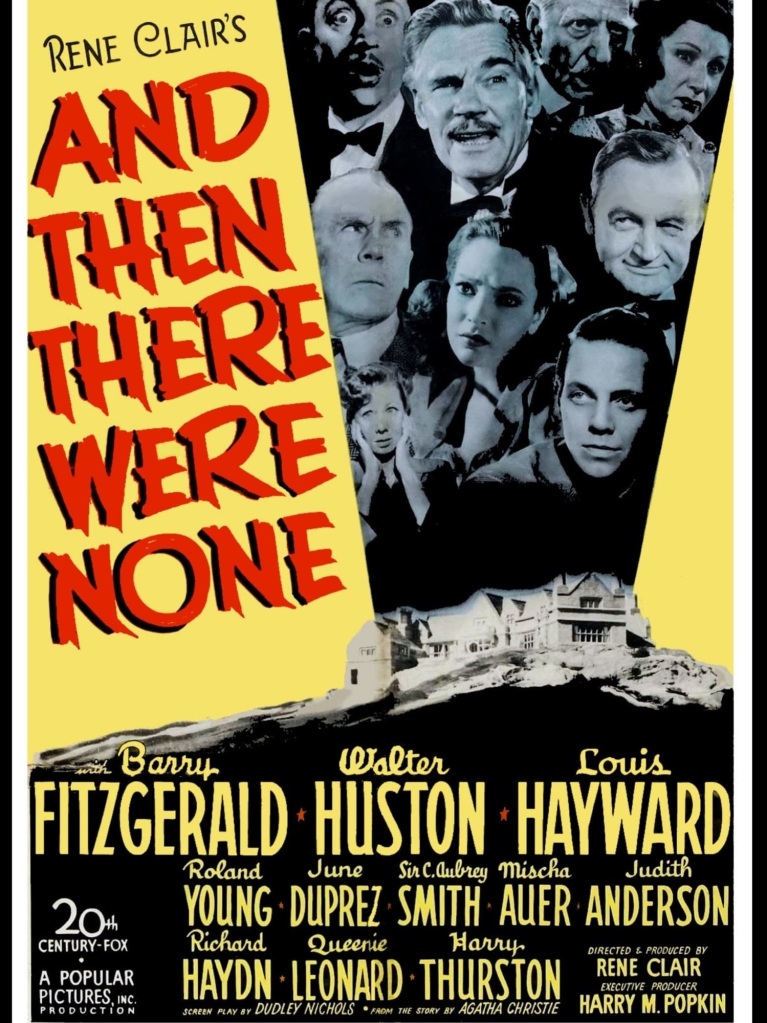
Agatha Christie’s And Then There Were None was published in 1939. Six years later came the first movie adaptation in 1945 made by Rene Clair. This is a mystery set on an island off the coast of england. 10 people are called to an island by the mysterious U. N. Owen. They each end up being accused by gramaphone of murder. The trip they each thought they were going to have soon turned into an investigation on who might be behind all of this. Each one of the guests are being killed one by one all following a child nursery rhyme. Little figures slowly start disappearing with the deaths of each person killed on the island giving clear evidence of their deaths.
The options for who might U. N. Owen be are slimming and two questions are still left to be found out, who is this strange figure, and who is next on the chopping block?
Justice Quinncannon, originally named Justice Wargrave in the book, takes the lead from time to time. The name was changed to fit the the popular Irish actor Barry Fitzgerald. He is a small but powerful man putting together clues on who could be the killer. Philip Lombard, played by Louis Hayward, slyly tried to figure out the situation and Vera, played by June Duprez, tried to stay alive determined to make it off the island.
The movie is in black and white but that did not sway me away from enjoying it. I really enjoyed Alfred Hitchcock’s Psycho, which was also in black and white. Sometimes the actors can be a bit much like when Prince Niki died, who was the replacement for Athnony Martson. He flailed around grabbing onto everything then eventually fell but with it being in 1945 actors were still trained for stage performances. There were plenty of small changes like the names of the people killed by each guest on the island and things like when Wargrave died he was wrapped in the crimson curtain like the judge robe and had a wig made of miss brents missing gray wool but in the movie Quinncannon was still in his original clothes without any changes. But then some more major changes like the ending. Without giving anything away we’ll say that it went from a more serious gloomy mood to a somewhat upbeat mood with two heroes.
Now for me, I wasn’t a huge fan of the movie ending. I’ve seen plenty of good endings with heroes and everything; it’s the most common ending to a movie if its a one off or the end to a series. Even Blumhouse when they made their Halloween movies ended there three movie saga with a hero and the big bad Micheal Myers defeated once and for all (however if you ask me I feel they should’ve added something where he was still alive leading you into whoever decides to make more).
Agatha Christie’s ending to her book was interesting because of its doom and gloom look. It stood out from the usual heroes defeating whatever conflict they were put up against, However she did herself, when it was adapted to a play, lighten the ending yet it still feels typical.
The movie was still good with interesting characters. To me I personally liked Prince Niki better than Anthony Marston because of his comical and outward personality rather than self centered and that’s it. Some characters I wish would have had more development like General Mandrake who was originally named Macarthur but was changed so there wouldn’t be confusion between the famous American General. He was only there for a brief moment in a few scenes and then killed off but had a few gags with him and his hearing aids. They did try to throw in a little development but kinda fell flat for me. After Mrs. Rogers died he says, after being yelled at so he can hear, “oh no a man would never kill his wife”. There’s also a part where Miss Brent goes off for a walk then comes in with seaweed and it felt out of place. Sure it was probably used to explain the seaweed in Vera’s room but if the scene wasn’t included in the movie it would’ve still have had the same effect.
I do like some of the directors’ choices for cutting long expositions. In one scene when the guests are crowded around the table they summed up a part of the dialogue by zooming in on Lombard’s face and having him say “Mr Lombard was unable to deny a thing” which to me was interesting as I have never really seen that in a movie before. I’ve seen things where they just cut over to the next scene or fade to the next scene or something obstructs the camera’s view for a moment and they skip a small unneeded portion like a montage but small jumps instead but not any self narration for narration. The extent of what i’ve seen is someone like the producer or the director or a regular actor would narrate. For it being on an island and there not being many places you can film or for it being just twenty-one year shy of being one hundred years old it still holds up to modern movies. It doesn’t have intense CGI but it doesn’t contain any Adam West Batman cheese like the Boom, Bang, and Pow images when action happens either. It may not have the best camera or audio quality but, if anything, it helps add to the time period when the story takes place. Overall I think there’s a slight charm added to it with it being an older movie and would in the future be added to a list of black and white movies I would rewatch. It also did stay rather true to Agatha Christie’s book and still does have those twists her work is greatly admired by.
I give this movie 🍿🍿🍿🍿 out of five popcorn buckets. Worth the watch. If you would like to give it a try yourself, you can find the full movie in the public domain on YouTube, or just enjoy the video here.
 Brunner's Bar
wow!! 0I Was a Teenage Slasher by Stephen Graham Jones
LikeLike